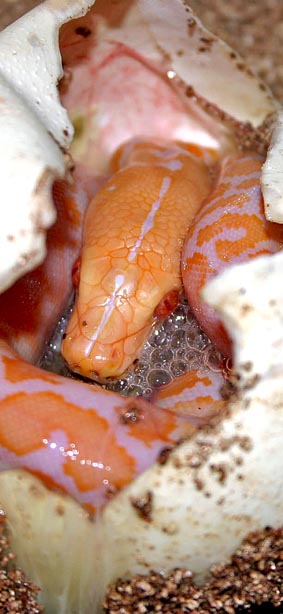
Python reticulatus is arguably the largest snake in the world. The record reported
length was over 33 feet. Retics have the largest distribution of any of the pythons, ranging throughout southeast Asia
and Indonesia. They are named for their intricate pattern. Retics are highly intelligent and curious snakes.
They used to have quite a reputation among hobbyists as nasty captives, but the more they have been bred in captivity, the
more this reputation has disappeared. This, along with the rising popularity of color and pattern morphs, such as tigers
and albinos has made Retics one of the most popular hobby snakes.
Sexual dimorphism is extreme
in this species. Adult females average 30% to 50% larger than adult males. This is not surprising due to the many
large eggs she must carry. Sex is determined in snakes by inserting a metal probe into the anal vent. If the probe
is able to be inserted an average length of 8 or more sub-caudal scales deep, than the specimen is determined to be male because
only an inverted penis, or hemipene, would have such a deep space in the tail. A female has much less space in
her tail, so the probe will only go 3 or 4 scales deep. The size difference between the sexes is so predictable, that
researchers and zoologists will not sex a specimen that measures more than 20 feet in length, because 99 times out of 100
it will be female. A few retics have been measured over 30 feet in length, although 14-19 feet is the average
size for captive specimen, and no Retic over 26 feet in length has been seen in a long time. Males also tend to
have proportionately smaller heads and larger spurs. Spurs are small pointy appendages on either side of the anal vent.
Each python has a pair. They aid the animals in locking onto each other during copulation. Many believe that they
are the evolutionary left overs of legs.
Males are typically sexually
mature at 10 feet in length, and females at 13 to 14 feet in length. Retics have been bred every month of the year in
captivity, but in the wild are seasonal breeders breeding from September through November. Males will combat. Gestation
can vary from a single mating from 60 to 100 days. Maternal incubation ranges from 86 to 95 days at a temperature of
88F to 91F. Twenty to 100 eggs are laid. The female does not build a nest, but does find a suitable, secure location
for egg laying. If the ambient temperature is not high enough, the female will 'sun' herself to raise her body temperature
and than return to the clutch to transfer the heat to the eggs. Young are not at all cared for once they hatch.
Retics, like most Pythons, have
heat pits. The pits are prominent on the snake's face and obvious in pictures. These pits allow the snake, in
effect, to see in thermal. They detect the body heat of prey items. Their prey selection in the wild is quite
varied, but among their favorites are Lion Tailed Macaques, an old world primate. Captive specimens are fed rats, rabbits
and even goats and pigs. Another interesting anatomical feature is their prehensile tails. Their tails are quite
long in comparison to other snakes, and are also very strong. Retics are easily the largest reptile to climb regularly
and their prehensile tails are monumentally important to this process. A 16 foot retic can have a 24" tail.
Perhaps
the most exciting fact about retics is the variability of their adult size. Dwarf populations were discovered some time
ago on remote islands in the Indian ocean. Recently these animals have been integrated into captive collections.
While adult mainland retics can reach enormous sizes, dwarf animals can reach adulthood while staying under 10 feet in length
and weighing little more than a large rat snake (in some cases). I don't believe there is any other species that has
this kind of variability. As color and pattern mutations are integrated into dwarf animals, the retic's popularity will
skyrocket. Few can resist the attractiveness of the retic, but most are scared off by their size and reputation.
The reputation is quickly going away and the size is much less of an issue now as well. Soon everyone will be able to
enjoy these magnificent, modern day dinosaurs.
"The Reproductive husbandry of Pythons and
Boas" by Ross and Marzec was used as a reference for some of this information.